
Project risk management and the risk register
Listen to this lesson
Nigerian voice narration
Fictional training case. Your school's graduation ceremony is in six weeks, with 400 guests and a ₦3.8 million budget. Last year, rain flooded the open-air venue, the generator failed during speeches and the caterer arrived two hours late. The principal says, 'This year, I don't want surprises.' This lesson teaches you to identify, assess and plan for risks before they happen.

Introduction and objectives
A risk is an uncertain event that could affect project objectives if it occurs. In this lesson you will learn to identify risks, assess probability and impact, prioritise them, build a risk register, choose response strategies and monitor risks. By the end you should be able to produce a risk register for any project.
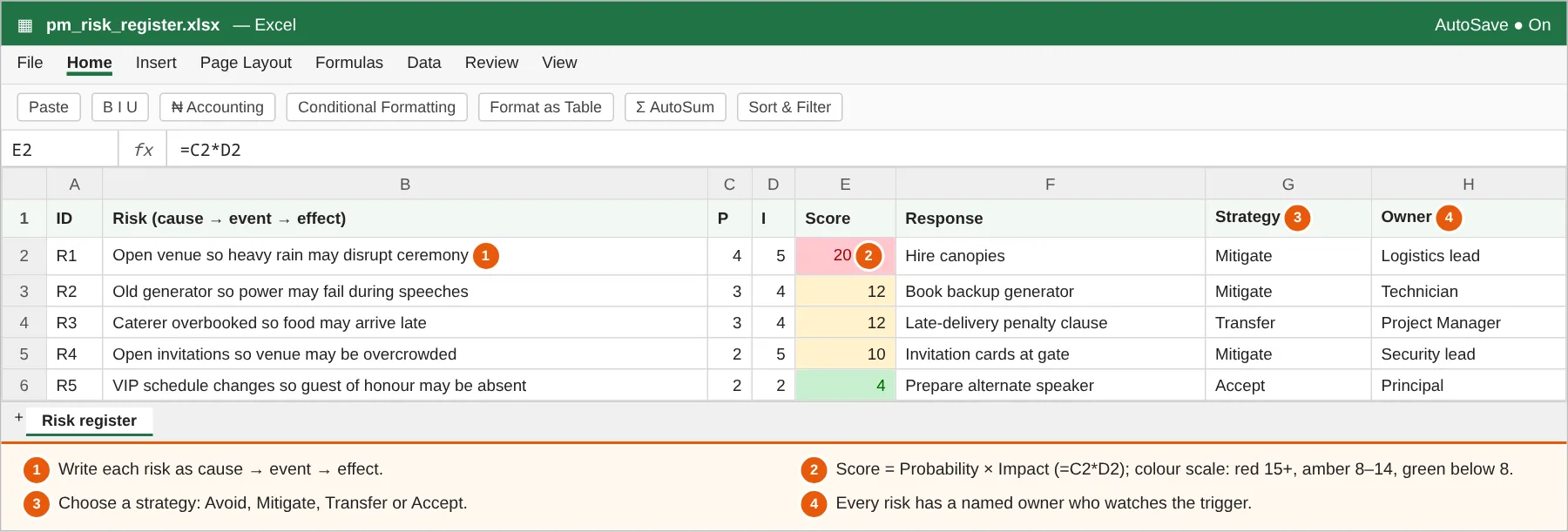
Try it yourself — step by step
- Open pm_risk_register.csv in Excel.
- Write each risk as cause → event → effect in column B.
- In E2 type =C2*D2 to score probability × impact; copy down.
- Select column E → Conditional Formatting → Color Scales (red high, green low).
- Fill Strategy and Owner for every risk, then sort by Score, largest first.
Identifying risks
Use brainstorming with the team, lessons from past projects, checklists and expert advice. Phrase each risk as cause–event–effect: 'Because the venue is open-air, heavy rain may occur, disrupting the ceremony.' For the graduation, risks include rain, generator failure, late caterer, VIP absence, overcrowding, budget shortfall and sound system failure.
Assessing and prioritising
Rate each risk's probability (1 = rare to 5 = almost certain) and impact (1 = minor to 5 = severe). Multiply them for a risk score. Rain in June: probability 4 × impact 5 = 20, high priority. Late caterer: 3 × 4 = 12, medium. A VIP absent: 2 × 2 = 4, low. Focus effort on high scores first.
Risk response strategies
For threats there are four responses. Avoid: change the plan to remove the risk, such as moving to an indoor hall. Mitigate: reduce probability or impact, such as hiring canopies and a backup generator. Transfer: shift it to another party, such as a caterer contract with a late-delivery penalty. Accept: tolerate minor risks, perhaps with a contingency fund.
Build the prompt from three phrases — Role, Task and Format — and watch the AI answer.
The risk register and monitoring
A risk register records each risk's ID, description, probability, impact, score, owner, response, trigger and status. The owner watches the trigger — for example 'NiMet forecasts rain above 60%' — and activates the response. Review the register at every progress meeting, close risks that have passed and add new ones as they appear.
Common mistakes to avoid
Many teams list risks once and never revisit the register. Others write vague risks such as 'problems may occur', fail to name an owner, or confuse issues (things already happening) with risks (things that might happen). Do not ignore low-probability, high-impact risks like fire or a stampede.
Practice exercise
Download the sample risk register. Add eight risks for a project you know, score each for probability and impact, assign an owner, choose a response strategy and write a trigger. Highlight the top three by score.
Lesson summary
Identify risks in cause–event–effect form, score them by probability and impact, and prioritise the highest. Respond by avoiding, mitigating, transferring or accepting. Keep a risk register with owners and triggers, and review it at every progress meeting.
You are a risk management specialist for events. Create a risk register for a 400-guest school graduation ceremony with a ₦3.8 million budget as a table: risk, probability, impact, score, response, owner.
Answer all three questions and check your answers to unlock the next lesson. Pass mark: 2 of 3.
Hiring canopies and a backup generator is which risk response?
Adding a late-delivery penalty clause to the caterer's contract is an example of…
What is the difference between a risk and an issue?