
Candidate Selection and Interviewing
Listen to this lesson
Nigerian voice narration
Fictional training case. Fictional case. Eighty people applied for one Administrative Officer role at Kowa Microfinance, Kaduna. The application deadline has passed, the branch manager wants 'the best person by Friday', and two applicants are related to senior staff. You must screen, shortlist, interview and recommend a candidate in a way that survives scrutiny.

Introduction and learning objectives
This lesson covers receiving and tracking applications, screening CVs against published criteria, shortlisting with a scoring sheet, preparing structured interview questions, conducting a fair interview, scoring and checking references, making the decision and preparing an offer letter. By the end you should be able to run a selection round that is consistent, documented and defensible.
Receiving and tracking applications
Use one application route so every candidate submits the same information. A Google Form linked to a Sheet is free and keeps responses in one place. Give each applicant an ID, record the date received, the role, the source channel and the status. Do not accept late or incomplete applications unless the advert allows it. A tracker prevents the chaos of applications spread across email, WhatsApp and paper envelopes, and it makes it easy to tell a candidate where their application stands.
Screening CVs against the criteria
Screening is a yes/no check against the essential criteria in the person specification, not a search for the most impressive story. Create a simple checklist: qualification, years of relevant experience, required software skill, location or availability. Score each criterion consistently. Ignore name, gender, age, ethnicity, religion and photographs. If a criterion needs clarification, apply the same rule to everyone. Keep the screening sheet; it is the first record of a fair process.
Shortlisting with a scoring sheet
A shortlisting sheet turns judgement into a documented score. List the criteria, decide the maximum score for each and what evidence earns it, then score every applicant. Rank the scores and invite the top group, but review borderline cases together rather than alone. Note the reason for any exception. Shortlist a realistic number: five to eight candidates for one role is usually enough to interview properly. Tell unsuccessful applicants promptly and keep their data only as long as policy allows.
Preparing structured interview questions
Structured interviews ask every candidate the same core questions in the same order, based on the job criteria. Use a mix of experience questions ('Tell us about a time you resolved a record error'), situational questions ('A staff member disputes a deduction; what do you do?') and practical tasks ('Build this simple spreadsheet'). Prepare a scoring guide for each question so interviewers know what a strong, average and weak answer looks like. Avoid questions about family plans, religion or personal relationships.
Conducting a fair interview
Start by explaining the format and the role. Ask one question at a time and let the candidate finish. Take brief notes using the candidate's words, not your impressions. Give every candidate the same opportunity to ask questions. If a panel is used, agree the roles beforehand: one person leads, another takes notes, another probes. Do not discuss the candidate while they are present. Manage time so no candidate gets a rushed or unusually long interview.

Build the prompt from three phrases — Role, Task and Format — and watch the AI answer.
Scoring, references and the decision
Score each candidate immediately after the interview against the prepared guide, then compare scores. Where scores are close, look at the evidence, not likeability. Contact referees for the preferred candidate with consent and ask job-related questions: dates of employment, duties, performance and reason for leaving. Verify certificates and identity before the offer. Record the panel's recommendation and the reason. The final decision belongs to the authorised manager, not to one interviewer's impression.
Preparing the offer letter
An offer letter should state the job title, department, reporting line, start date, location, salary and allowances, contract type, probation, notice period, leave and any conditions such as reference or certificate checks. Refer to the full contract and any policies. State the deadline for acceptance. Send it through an official channel and keep a signed copy. Do not promise benefits that are not approved. A clear offer prevents disputes before the employee's first day.
Step-by-step: shortlist to offer
1) Export applications to a sheet with an applicant ID. 2) Score each against the essential criteria. 3) Sort by score and agree the shortlist with the panel. 4) Invite candidates with the date, time, location, format and documents required. 5) Prepare the question guide and scoring sheet. 6) Interview and score every candidate. 7) Check references and certificates for the preferred candidate. 8) Obtain approval and issue the offer letter. 9) Record the outcome and notify unsuccessful candidates.
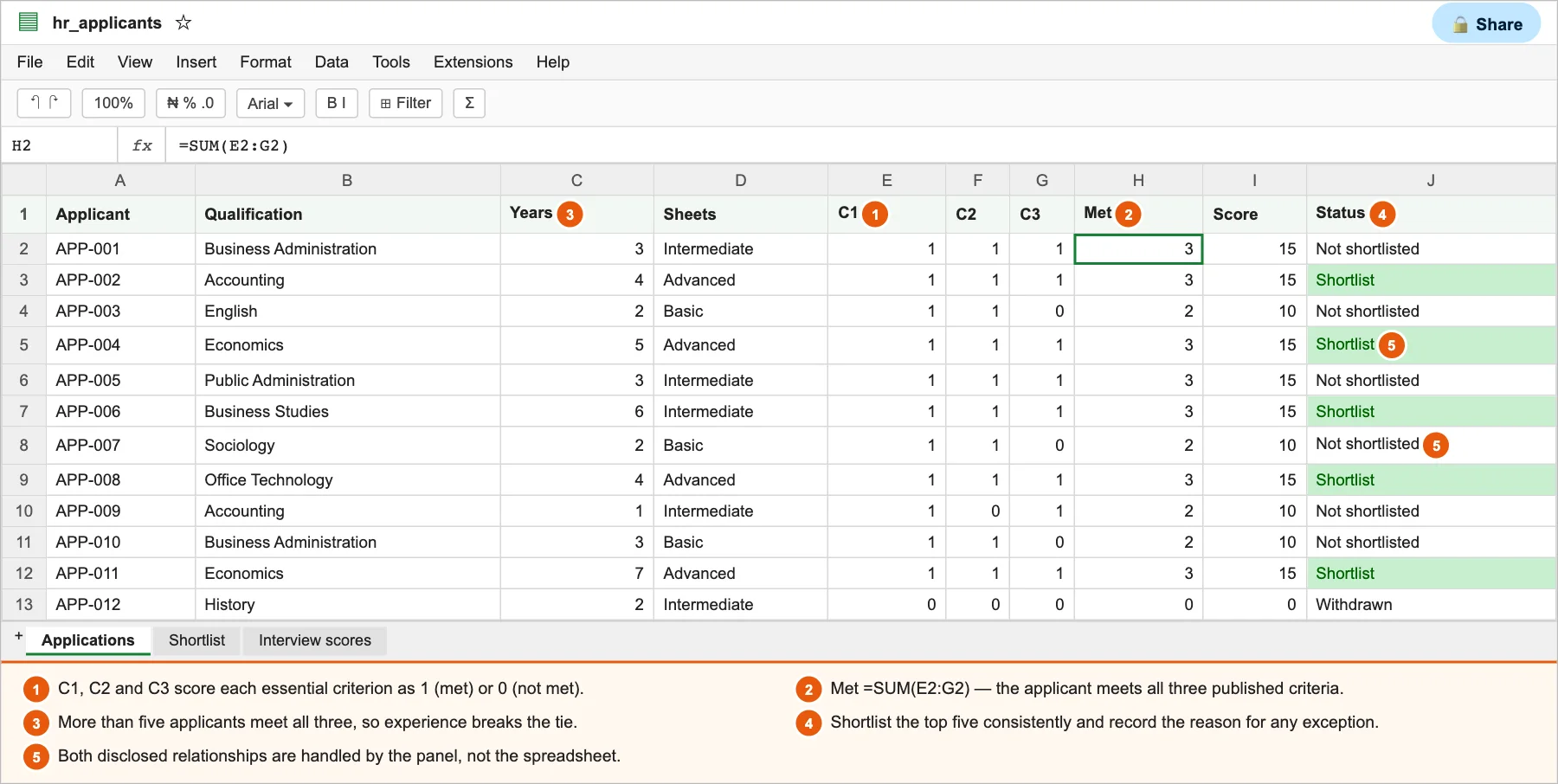
Try it yourself — step by step
- Open hr_applicants.csv and add columns C1, C2 and C3.
- Score 1 for met and 0 for not met against the three published criteria.
- In Met type =SUM(E2:G2) and copy down.
- Sort by Met, then years of experience, and shortlist the top five.
- Record the reason for each exception and route disclosed relationships to the panel.
Common mistakes to avoid
Common mistakes are deciding before the interview, asking different questions to different candidates, scoring from memory hours later, letting a senior relative influence the panel, failing to verify certificates, and making a verbal offer that differs from the letter. Another mistake is keeping unsuccessful applicants' data indefinitely. Document decisions, apply the same criteria to everyone and keep personal data secure.
Practice exercise
Using the downloadable applicant dataset and interview scorecard, screen the applicants against three essential criteria, shortlist five and prepare six structured interview questions with a scoring guide. Write a short offer letter for the top candidate using the template fields. State how you handled the two applicants related to senior staff.
Lesson summary
Track every application. Screen and shortlist against published criteria using a scoring sheet. Use structured questions and score immediately. Check references and documents. Record the decision and issue a clear offer. Consistency and documentation make selection fair and defensible.
Open Google Gemini (free tier) and paste this prompt there. Suggests structured interview questions from the published criteria only.
You are an HR selection adviser. Create six structured interview questions and a scoring guide for an administrative officer role as a table: question, what strong evidence looks like, score 1-5.
Why this tool: Suggests structured interview questions from the published criteria only.
Hit a free limit? Switch to ChatGPT or Gemini and continue — the prompt works in any assistant.
Answer all three questions and check your answers to unlock the next lesson. Pass mark: 2 of 3.
During CV screening, you should ignore…
The best time to score an interview is…
An offer letter should…