
Employee Training and Development
Listen to this lesson
Nigerian voice narration
Fictional training case. Fictional case. GreenField Academy has approved a small training budget for the year. The principal wants training that solves real gaps, not a list of popular courses. You must identify needs, prepare a plan, organise affordable sessions, evaluate the results and report to management.

Introduction and learning objectives
This lesson explains why training matters, how to identify training needs at organisation, role and individual level, how to prepare and cost a training plan, how to organise training on a budget, develop skills through mentoring and on-the-job practice, evaluate effectiveness and report results. By the end you should be able to turn a vague training request into an evidence-based plan.
Why employee training matters
Training improves the skills staff need to do today's job and prepares them for tomorrow's. It supports quality, safety, compliance, retention and morale. It also protects the organisation when systems, laws or customer expectations change. Training is not a reward or a one-off event; it is an investment that should be linked to a performance or business need. Untrained staff make avoidable errors, and training without follow-up is quickly forgotten.
Identifying training needs
Training needs analysis looks at three levels. Organisation level: what skills does the business need to grow or comply? Role level: what does the job require, and where are the gaps? Individual level: what does this person need to improve performance? Use appraisals, error reports, customer complaints, attendance data, staff surveys and supervisor interviews. Distinguish a training need from a process or resource problem: if a form is confusing, fixing the form may be better than training people to cope with it.
Preparing a training plan
A training plan states the need, the target group, the learning objectives, the method, the provider, the duration, the cost, the date and the way effectiveness will be measured. Prioritise by risk and impact, not by who asked loudest. Include low-cost options such as internal sessions, peer learning, free online courses and on-the-job practice. Agree the budget and approvals. A one-page plan is enough if it is specific and realistic.
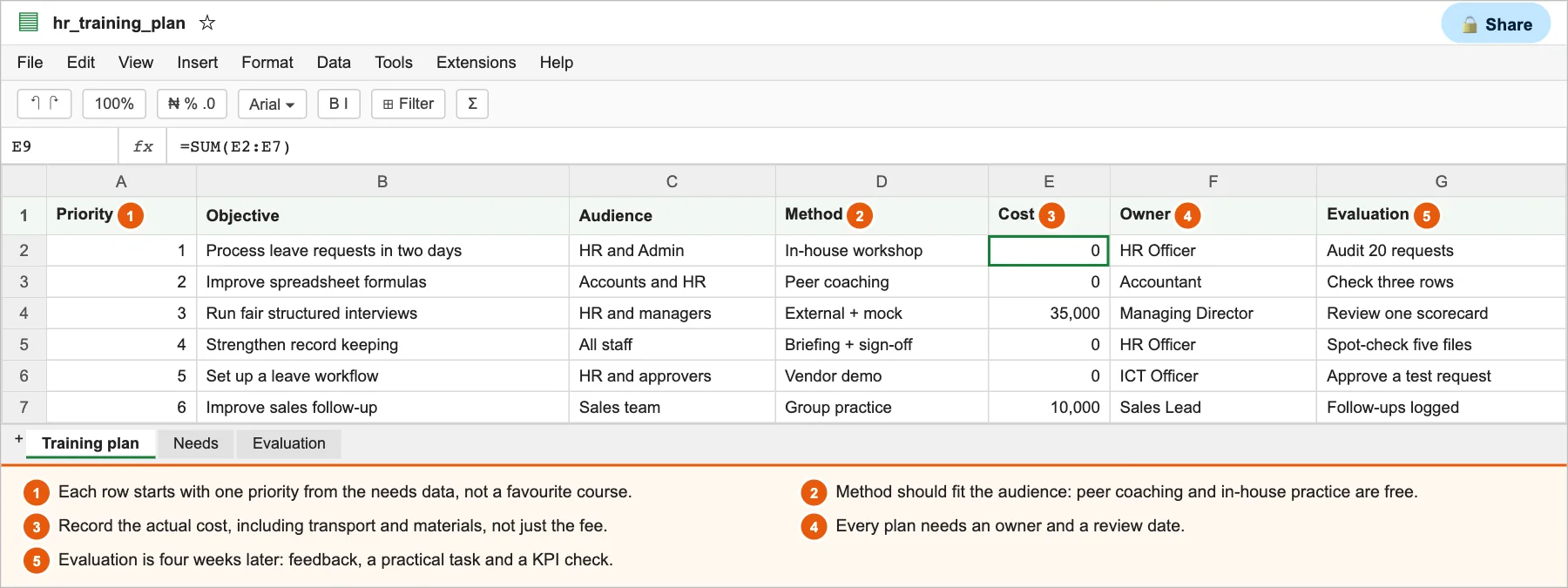
Try it yourself — step by step
- Start from the training-needs data, not a favourite course.
- Choose a method that fits the audience; peer coaching and in-house practice are free.
- Record the full cost, including transport and materials.
- Name an owner and a review date for every action.
- Plan evaluation four weeks later: feedback, practical task and KPI check.
Organising staff training on a budget
For each session, confirm the facilitator, venue or online link, materials, attendance list and schedule. Tell participants why they are attending and what they should be able to do afterwards. Avoid pulling the whole team out at once; plan cover. Record attendance and share materials. Use free resources where they are reliable, and check that any certificate or content is current. After the session, collect feedback and a short action plan from each participant.
Skills development, mentoring and on-the-job learning
Not all development happens in a classroom. Pair a less experienced staff member with a mentor, assign a stretch task with support, rotate duties or create a small improvement project. Encourage staff to apply one new skill within two weeks. Managers should coach in the flow of work, not wait for a course. Recognise progress. On-the-job learning is often the cheapest and most relevant form of development.
Build the prompt from three phrases — Role, Task and Format — and watch the AI answer.
Evaluating training effectiveness
Evaluate at four simple levels: reaction (did participants find it useful?), learning (can they demonstrate the skill?), behaviour (are they using it at work?) and results (did the target measure improve?). Use a short survey, a practical task, supervisor observation and the original KPI. A happy evaluation sheet does not prove behaviour change. Follow up after four to six weeks and record what changed. If nothing changed, ask whether the need was correctly identified.
Preparing training reports
A training report summarises needs, activities, attendance, cost, evaluation results and next actions. Include the number of staff trained, the skills covered, completion rates and evidence of impact. Note any provider or budget issues. Use aggregate data and avoid unnecessary personal details. Share the report with management and use it to plan the next cycle. The report should answer: what did we buy, what changed and what should we do next?
Using AI to develop training materials
ChatGPT and Gemini can draft session outlines, case studies, quizzes and handouts from the learning objectives you supply. They can adapt a technical topic into plain language and suggest activities. They cannot guarantee factual accuracy or local relevance. Review every draft, add Nigerian examples and verify any legal, tax or technical statement. Do not paste real staff performance data into a public AI tool. Use fictional or anonymised examples.
Common mistakes to avoid
Common mistakes are running training because it is popular, skipping the needs analysis, inviting everyone regardless of role, measuring only attendance, and failing to follow up after the session. Another mistake is using AI-generated content without checking facts or local context. Link every course to a need, a measure and a follow-up action.
Practice exercise
Using the downloadable training needs form and plan template, analyse the fictional needs data and select the top three priorities. Prepare a one-page plan with objectives, audience, method, cost and evaluation. Write five survey questions to evaluate a session four weeks later and one way to check whether behaviour changed.
Lesson summary
Training should follow evidence of need. Analyse at organisation, role and individual level. Plan objectives, methods, cost and evaluation. Use affordable and on-the-job options. Measure reaction, learning, behaviour and results. Report what changed. Verify AI-generated materials.
Open ChatGPT (free tier) and paste this prompt there. Drafts training plans and exercises from a verified needs list.
You are an HR training coordinator. Turn these needs into a one-page training plan: supervisors poor at feedback, staff weak in spreadsheets, leave tracker errors as a table: need, audience, method, cost, date, success measure.
Why this tool: Drafts training plans and exercises from a verified needs list.
Hit a free limit? Switch to ChatGPT or Gemini and continue — the prompt works in any assistant.
Answer all three questions and check your answers to unlock the next lesson. Pass mark: 2 of 3.
A training need is different from a process problem because…
The strongest evidence that training worked is…
Before using AI-generated training content, you should…