
Employee Performance Management
Listen to this lesson
Nigerian voice narration
Fictional training case. Fictional case. Zamani Foods Ltd has an annual appraisal form that supervisors sign without discussion. Staff say they do not know what good performance looks like, and the MD wants clearer targets and fewer surprises at year end. You are asked to redesign the process with measurable goals and honest feedback.

Introduction and learning objectives
This lesson explains the performance management cycle, setting employee goals, choosing KPIs, measuring performance, conducting reviews, using an appraisal form, giving constructive feedback and preparing performance reports. By the end you should be able to set clear goals, run a fair review conversation and document the outcome.
Understanding performance management
Performance management is the ongoing process of agreeing what good work looks like, supporting the employee to achieve it and reviewing progress. It is not a once-a-year form. The cycle runs from planning goals, through coaching and monitoring, to review and development. Appraisal is one formal checkpoint in that cycle. When managers give feedback regularly, the appraisal conversation confirms what both sides already know rather than delivering a surprise.
Setting employee goals
A useful goal is specific, measurable, achievable, relevant and time-bound. Instead of 'improve record-keeping', write 'complete the monthly staff register by the 3rd working day, with fewer than three missing fields'. Align individual goals with the department's priorities so effort is not wasted. Limit each role to five or six goals. Include a mix of results and behaviour. Review goals when circumstances change, with the employee's knowledge.
Key performance indicators
A KPI is a measure that shows whether a goal is being achieved. Good KPIs are within the employee's influence, based on reliable data and easy to explain. Examples: days to fill a vacancy; payroll error rate; percentage of leave requests decided within two working days; new-hire retention at 90 days; training completion rate; grievance cases resolved within policy time. Avoid vanity measures that look impressive but do not reflect real work. Agree the data source before the period starts.
Try it yourself — step by step
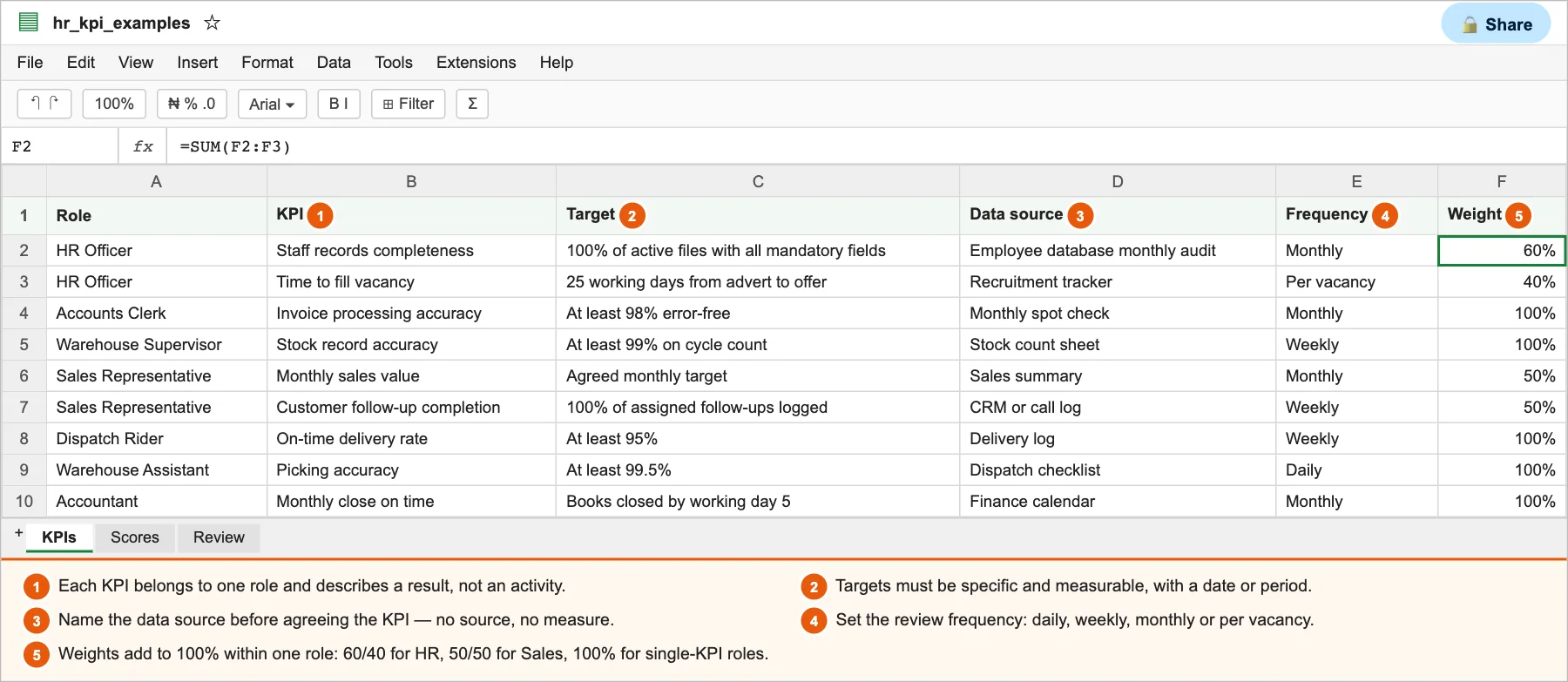
- Open hr_kpi_examples.csv; keep one result per row.
- Write a target with a number and a period.
- Name the data source before agreeing the KPI.
- Set a review frequency for each measure.
- Weights for one role must add to 100%.
Measuring employee performance
Use more than one source: agreed targets, supervisor observation, work samples, customer feedback, attendance and peer input where appropriate. Check the data before the review. Distinguish results from behaviour: a person may hit targets while damaging the team. Keep notes during the year so the review is based on evidence, not the last two weeks. Be aware of bias such as recency, halo effects and favouritism, and test your rating against specific examples.
Conducting performance reviews
Prepare the employee in advance with the form, their goals and the evidence. Start with the purpose and the agenda. Discuss results against each goal, then behaviour and development. Invite the employee's view before giving yours. End with agreed actions, support and dates. Keep the tone calm and factual. Record the agreed outcome and give the employee a copy. A review is a two-way conversation, not a verdict delivered from above.

Build the prompt from three phrases — Role, Task and Format — and watch the AI answer.
Using an appraisal form
A practical form covers employee details, review period, goals and results, competencies, evidence, employee comments, supervisor rating, development actions and signatures. Use a simple rating scale with definitions, for example 1 = below expectation, 3 = meets, 5 = exceeds. Require an example for any rating below or above the middle. Avoid vague comments such as 'good attitude' without evidence. The form is a record of a conversation, not a substitute for one.
Giving constructive feedback
Constructive feedback describes the behaviour, its impact and the desired change. Instead of 'you are careless', say 'the last three leave reports had missing dates; that delayed payroll; please use the checklist before submitting'. Give feedback privately and promptly. Listen to the response. Separate the person from the behaviour. Recognise good work specifically. If the issue is serious, move to a documented improvement plan rather than repeating the same conversation.
Performance improvement plans and reports
A performance improvement plan (PIP) sets out the gap, the required standard, the support provided, the review dates and the consequence if the standard is not met. It should be fair, time-bound and documented. Share it with the employee and the supervisor. Prepare a periodic performance report for management: completion of reviews, rating distribution, key gaps, training actions and any unresolved cases. Use aggregate data, not unnecessary personal details.
Common mistakes to avoid
Common mistakes are setting vague goals, completing appraisals in a rush at year end, rating everyone the same to avoid conflict, giving feedback only when something goes wrong, and using a PIP as a punishment without support. Another mistake is ignoring evidence from the whole year. Document goals, check-ins and agreed actions so the process is fair and useful.
Practice exercise
Using the downloadable appraisal form and KPI examples, write five SMART goals for an administrative officer and a simple rating guide. Prepare a ten-minute review plan for an employee who met two goals but missed one. Write two constructive feedback statements with evidence and a clear requested change.
Lesson summary
Performance management is continuous: agree goals, support, monitor and review. Use measurable KPIs and evidence. Run appraisals as two-way conversations. Give specific, private feedback. Use a documented improvement plan when needed and report aggregate results.
Open Google Gemini (free tier) and paste this prompt there. Helps turn role duties into measurable KPIs and appraisal questions.
You are an HR performance adviser. Turn the administrative officer role into five SMART goals and a simple appraisal guide as a table: goal, KPI, data source, review date.
Why this tool: Helps turn role duties into measurable KPIs and appraisal questions.
Hit a free limit? Switch to ChatGPT or Gemini and continue — the prompt works in any assistant.
Answer all three questions and check your answers to unlock the next lesson. Pass mark: 2 of 3.
A KPI should be…
Constructive feedback should focus on…
A performance improvement plan should include…