
Payroll and Compensation Fundamentals
Listen to this lesson
Nigerian voice narration
Fictional training case. Fictional case. Kowa Microfinance pays 10 staff from a spreadsheet that only the former accountant understood. Two staff were underpaid last month, one deduction was applied twice, and the MD wants a payroll register that can be checked before the next payday. All names and figures in this lesson are fictional.

Introduction and learning objectives
This lesson explains payroll, salary structures, allowances and deductions, gross and net pay, a payroll register, PAYE and statutory deductions, benefits and payroll controls. By the end you should be able to prepare a basic payroll register from supplied assumptions, check it for errors and explain why current Nigerian tax and statutory rates must be verified before use. The exercises are educational, not tax advice.
Understanding payroll
Payroll is the process of calculating and paying employee earnings accurately and on time, while keeping records of deductions and employer contributions. It touches finance, HR and compliance. A payroll error damages trust and can create legal exposure. A good payroll process has approved inputs, a calculation sheet, a review by a second person, an approval, a payment file and a reconciliation. The payroll register is the core record that explains every figure.
Basic salary structures
A salary structure groups roles into grades or bands and defines the components of pay. A simple structure shows the grade, basic salary, housing allowance, transport allowance, other allowances and the gross. Keep the structure approved and consistent. Avoid secret individual deals that undermine fairness. Review the structure when the market, inflation or the organisation's budget changes. Staff should receive a clear statement showing their grade and components.
Allowances and deductions
Allowances add to pay: housing, transport, meals, responsibility, overtime or arrears. Deductions reduce pay: PAYE tax, pension contribution, loan repayment, cooperative dues, absence or damage where lawful. Every deduction needs a rule, an approval and a record. Do not deduct for an unclear reason or without the employee's knowledge. Statutory deductions must follow current law; voluntary deductions need the employee's written consent or a valid agreement.
Calculating gross and net salary
Gross pay is basic salary plus allowances and any overtime or arrears. Net pay is gross pay minus lawful deductions. Example with fictional figures: basic ₦150,000 + housing ₦30,000 + transport ₦20,000 = gross ₦200,000. If PAYE is ₦18,000 and pension employee contribution is ₦12,000, net pay is ₦170,000. The exact rates used here are illustrative only. Always use the current approved tax and pension rules, and check the arithmetic independently.
Preparing a payroll register
A payroll register has one row per employee and columns for staff number, name, grade, basic, allowances, gross, each deduction, total deductions, net pay, bank details and a check column. Add totals at the bottom and a variance column against last month. Use formulas, not typed totals. Protect the sheet and restrict access. Reconcile the total net pay to the payment file and the bank transfer before release.
PAYE and payroll compliance in Nigeria
Payroll compliance includes income tax through PAYE, pension contributions, and other levies that may apply to the organisation. Rates, bands, exemptions and filing deadlines change. Use the current guidance from the relevant Nigerian tax authority, pension regulator and a qualified professional. This course does not provide tax advice. Build a compliance calendar, keep remittance evidence and reconcile remittances to payroll. Never guess a rate or copy an old template without checking it.

Build the prompt from three phrases — Role, Task and Format — and watch the AI answer.
Employee benefits and total compensation
Benefits are non-cash or indirect rewards: health cover, leave, training, transport, meals, flexible hours, phone allowance or a pension contribution. Total compensation is salary plus benefits. Benefits can improve retention without raising basic pay, but they must be affordable, fairly administered and clearly explained. Review benefits periodically. A benefit that exists only in a verbal promise is a future dispute.
Payroll controls, confidentiality and reports
Separate the people who prepare, review and approve payroll. Require a second check before payment. Keep salary data in a restricted file, not in a shared folder. Do not discuss individual pay in public. Produce a monthly payroll summary for management showing headcount, gross, deductions, net and variances, without unnecessary personal details. Retain payroll records according to policy. Investigate every unexplained variance before the next run.
Step-by-step: build and check a payroll register
1) Collect approved inputs: new hires, exits, salary changes, leave without pay, overtime and loan approvals. 2) Update the employee master list. 3) Enter basic and allowances. 4) Apply deductions using current verified rules. 5) Calculate gross, total deductions and net with formulas. 6) Compare totals with last month and explain variances. 7) Have a second person check a sample of rows and the totals. 8) Obtain approval, prepare the payment file and reconcile the bank transfer. 9) Archive the approved register.
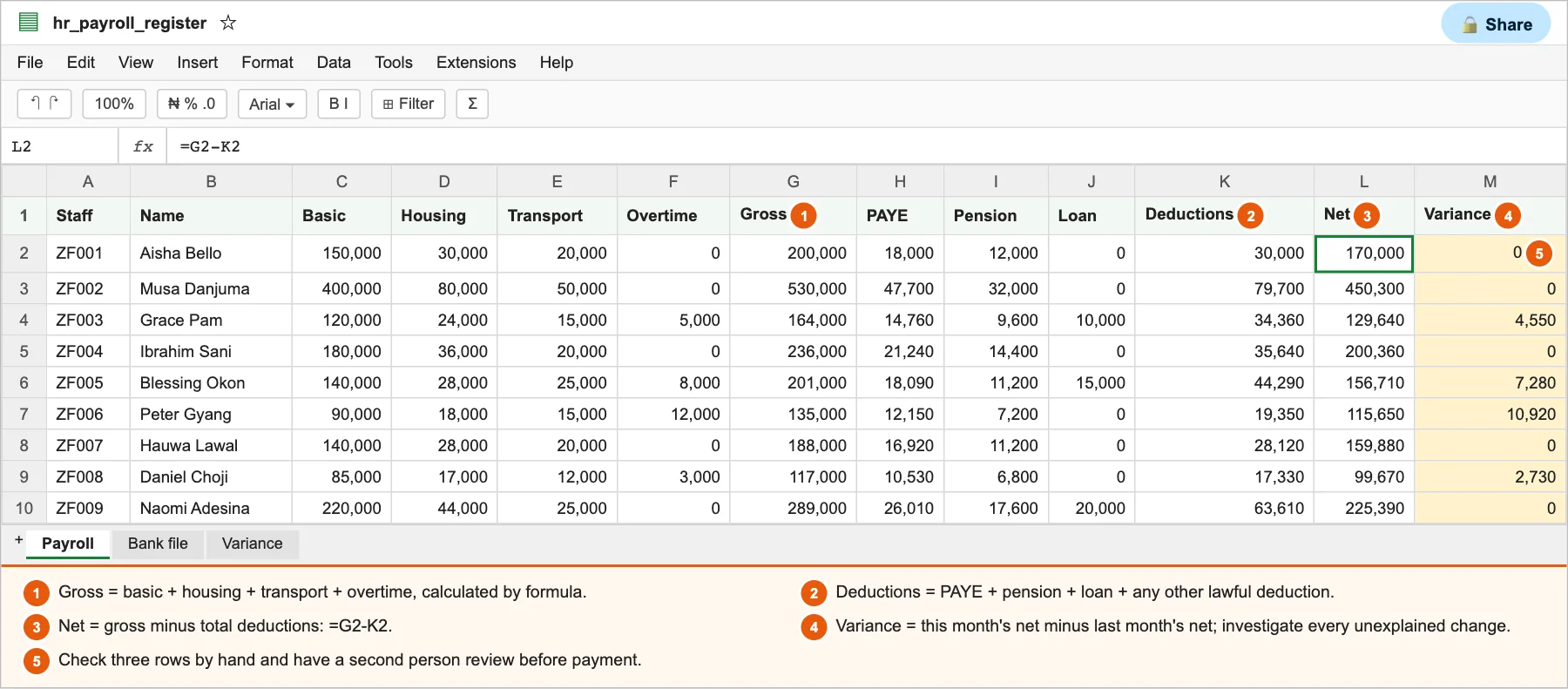
Try it yourself — step by step
- Open hr_payroll_sample.csv.
- In Gross type =SUM(C2:F2) for basic, housing, transport and overtime.
- Total PAYE, pension, loan and other lawful deductions.
- In Net type =G2-K2 and copy down.
- Check three rows by hand and have a second reviewer sign off.
Common mistakes to avoid
Common mistakes are typing totals instead of using formulas, paying from an outdated staff list, applying a deduction twice, using last year's tax rates, sharing the payroll file with everyone, and failing to reconcile the payment file with the register. Another mistake is making a verbal promise of an allowance that payroll never receives. Use approved inputs, formulas, a second check and a reconciliation.
Practice exercise
Using the downloadable payroll template and fictional sample data, calculate gross pay, total deductions and net pay for ten staff. Add a variance column against the previous month and explain two variances. Check three rows by hand. Write a short note listing the current Nigerian rates you would verify before using this in a real organisation.
Lesson summary
Payroll needs approved inputs, a clear salary structure, correct allowances and lawful deductions, formula-based calculations and a second review. Gross minus deductions equals net. PAYE and statutory rates must be verified from current authoritative sources. Protect salary data and reconcile every payment.
Open ChatGPT (free tier) and paste this prompt there. Explains gross-to-net calculations and payroll-report wording; verify all rates against current Nigerian sources.
You are a payroll administrator. Explain the columns and checks for a basic monthly payroll register as a table of columns with purpose, plus a six-step pre-payment checklist.
Why this tool: Explains gross-to-net calculations and payroll-report wording; verify all rates against current Nigerian sources.
Hit a free limit? Switch to ChatGPT or Gemini and continue — the prompt works in any assistant.
Answer all three questions and check your answers to unlock the next lesson. Pass mark: 2 of 3.
The safest source for current PAYE rates is…
A payroll register should be checked by…
A deduction that is not required by law should be applied only when…