
Customer Relationship Management Fundamentals
Listen to this lesson
Nigerian voice narration
Fictional training case. Fictional case. Amana Home Stores keeps customer details in a notebook, a phone contact list and the owner's memory. A repeat customer, Mrs Ngozi Eze, has bought from the shop four times but nobody recognises her. The owner wants to start a loyalty scheme and asks: 'What is CRM, and why should I pay for software when I already have WhatsApp?' You must explain the idea before recommending any tool.
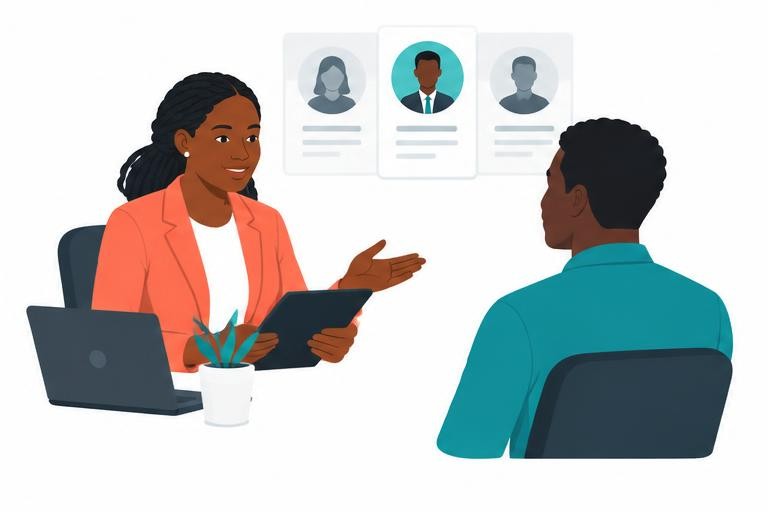
Introduction and learning objectives
This lesson introduces customer relationship management, why relationships drive repeat business, the stages of the customer journey, how to understand needs, acquisition and retention, loyalty, customer lifetime value and the role of CRM software. By the end you should be able to map a customer relationship and explain what a CRM should record, without confusing a contact list with a relationship.
Understanding customer relationship management
Customer relationship management (CRM) is the practice of recording and using customer information to build stronger relationships. It combines a way of working with a system: know who the customer is, what they bought, what they asked for, what they were promised and what should happen next. A notebook can be a basic CRM if it is complete and used consistently. Software helps when there are many customers, several staff and a need for reminders, reports and controlled access.
Why customer relationships matter
A relationship turns a one-off buyer into someone who returns, refers others and gives useful feedback. Relationship customers are cheaper to serve because their details and preferences are known, and they are more forgiving when something goes wrong. In a small Nigerian business, trust is often personal: customers return because a particular officer listened and kept a promise. That trust disappears when staff change and no record survives. A good CRM protects the relationship beyond one person's memory.
Introduction to the customer journey
The customer journey is the path from first awareness to repeat purchase and advocacy. A simple version has five stages: awareness, consideration, purchase, onboarding or first use, and retention or referral. At each stage the customer has questions and risks dropping off. A service officer should know which stage a customer is in. A first-time caller needs clarity and confidence; an existing customer needs history and speed; a lapsed customer needs a relevant reason to return.
Understanding customer needs
Customers rarely state the real need directly. 'Do you have a cheaper blender?' may mean the price is too high, the current model failed, or they need a smaller size. Ask clarifying questions and record the answer. Separate stated needs from underlying needs: a customer asking for a refund may really want a working product quickly. Accurate needs notes help the next officer respond without making the customer repeat the story.
Customer acquisition and retention
Acquisition means attracting new customers through adverts, referrals, location and outreach. Retention means keeping the customers you already have through good service, follow-up and relevant offers. Acquisition is usually more expensive than retention: a flyer, radio mention or paid advert may bring one new buyer, while a good experience can bring the same customer back several times. Small businesses often over-invest in acquisition and under-invest in answering messages, keeping promises and recording repeat buyers.
Building customer loyalty
Loyalty grows from reliability, recognition and fair treatment, not only discounts. Reliable delivery, honest advice and easy complaint handling build trust. Recognition means remembering a customer's name, preferred product or outstanding issue. Fairness means the same rule applies to everyone. A loyalty scheme can support these habits, but it cannot replace them. Never enrol a customer in a programme without consent or make them download an app just to receive basic service.

Build the prompt from three phrases — Role, Task and Format — and watch the AI answer.
Understanding customer lifetime value
Customer lifetime value (CLV) is the profit a customer brings over the whole relationship. A simple estimate is average purchase × purchases per year × years retained × profit margin. Example: a customer spends ₦40,000 twice a year for five years at a 20% margin, giving about ₦80,000 of gross profit. Seen this way, spending time to resolve a ₦6,000 complaint properly is an investment in a much larger relationship. CLV helps staff and owners prioritise retention over winning a single argument.
Introduction to CRM software
A CRM stores contacts, companies, deals, activities and notes, and reminds staff what to do next. HubSpot CRM has a free tier suitable for small teams, with contacts, deals, tasks and basic reporting. Google Sheets can serve as a simple customer database when the team is small and access is controlled. tawk.to is not a full CRM; it is a live-chat and support-ticketing tool that records conversations and tickets. Choose the simplest tool that gives accurate records, reminders and access control.
Step-by-step: map one customer relationship
1) Choose one repeat customer from the shop. 2) Write the first contact and what prompted it. 3) List every purchase, enquiry and complaint in date order. 4) Record what the customer values and what nearly went wrong. 5) Identify the next useful contact, such as a check-in or maintenance reminder. 6) Note what data is missing and who holds it. 7) Enter the record in a sheet or CRM with a follow-up date. 8) Review the record before the next interaction.
Common mistakes to avoid
Common mistakes are treating a phone contact list as a CRM, collecting personal data without a purpose, failing to record promises, letting each officer keep a private customer list, and buying software before defining the process. Another mistake is measuring loyalty only by discounts. A CRM with dirty or incomplete records is worse than a notebook because it creates false confidence. Start with a clear process, clean data and named owners.
Practice exercise
Using the downloadable customer journey map and lifetime-value worksheet, map one fictional repeat customer at Amana Home Stores across five journey stages. Record two needs, one risk and one follow-up per stage. Estimate the customer's lifetime value with clearly stated assumptions, then write six sentences explaining what the shop should record and why.
Lesson summary
CRM is a way of recording and using customer information to build relationships. The journey runs from awareness to retention and referral, and each stage creates different needs. Retention and loyalty are usually cheaper than acquisition. Customer lifetime value shows why small service failures matter. CRM software supports a clear process; it does not replace one.
Open Google Gemini (free tier) and paste this prompt there. Helps compare CRM concepts and tools; confirm current free-plan features on the vendor's own pages.
You are a CRM adviser for a small Nigerian retailer. Explain what a small shop should record about a repeat customer and estimate that customer's lifetime value as a five-field record list, then a short lifetime-value calculation with stated assumptions.
Why this tool: Helps compare CRM concepts and tools; confirm current free-plan features on the vendor's own pages.
Hit a free limit? Switch to ChatGPT or Gemini and continue — the prompt works in any assistant.
Answer all three questions and check your answers to unlock the next lesson. Pass mark: 2 of 3.
Which activity is retention rather than acquisition?
A customer asks for 'a cheaper blender'. The professional response is to…
Why is tawk.to not a complete CRM?