
Financial verification: suppliers, customers and payment approvals
Listen to this lesson
Nigerian voice narration
Fictional training case. Abuja Wholesale Stationers says your company owes ₦2,860,000. Your payables ledger shows ₦2,415,000. Meanwhile three customers dispute their balances, and an audit of 40 payment vouchers finds six approved by an officer above his limit. Management wants a verification report by Friday. This lesson covers supplier and customer verification and approval testing.

Introduction and objectives
Beyond the bank, auditors verify balances with suppliers and customers and test whether payments were properly approved. This lesson teaches supplier statement reconciliation, customer balance confirmation, approval-limit testing and preparing a reconciliation report. By the end you should be able to explain differences and report them clearly.
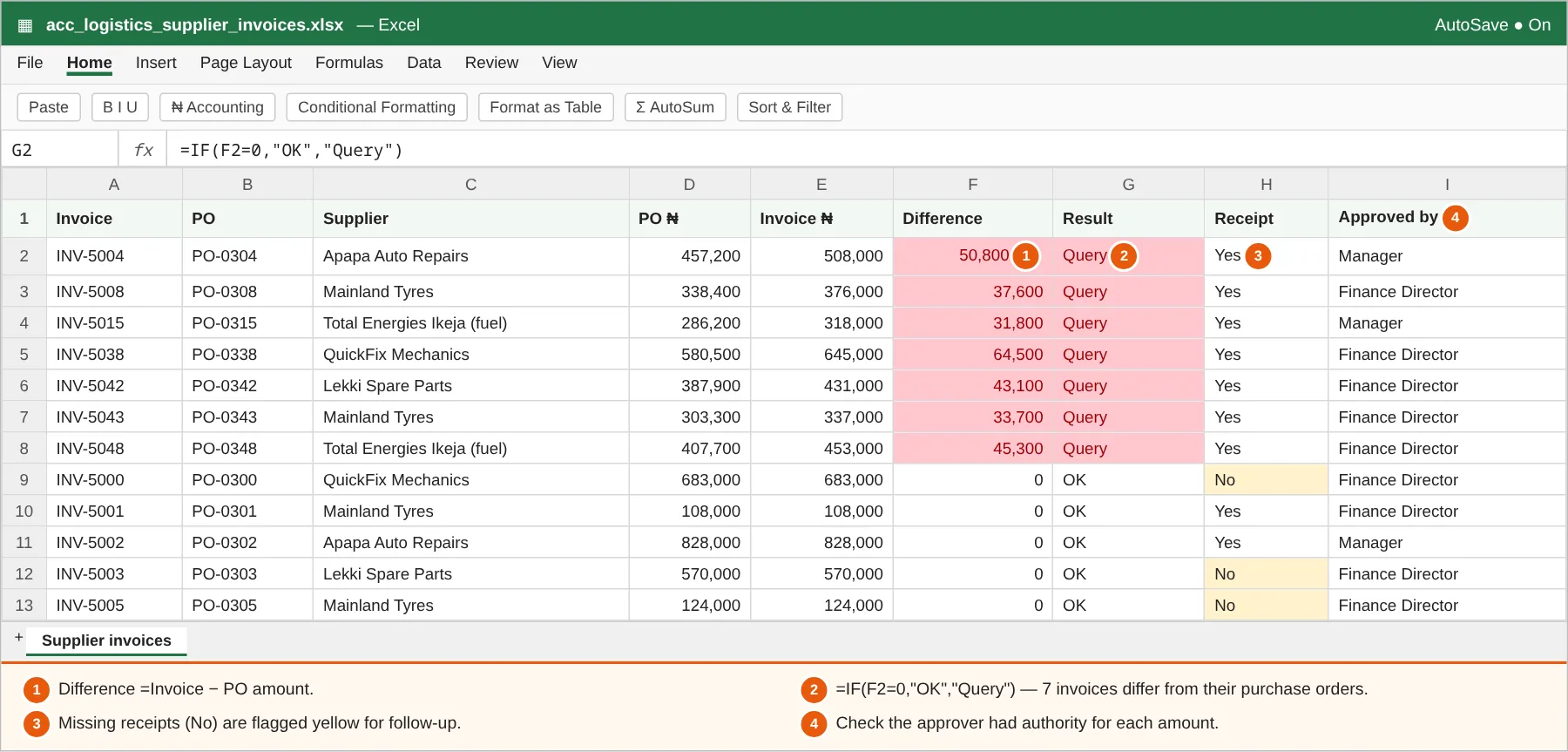
Try it yourself — step by step
- Add a Difference column: =Invoice_Amount − PO_Amount.
- Add a Result column: =IF(difference=0,"OK","Query").
- Filter Result = Query and Receipt_on_file = No.
- For each item, check the approver's limit and request supporting documents.
Supplier statement reconciliation
Compare the supplier's statement with your ledger line by line. Typical differences: invoices on the statement not yet received or recorded (₦320,000), payments you made that the supplier hasn't applied (₦150,000), credit notes not recorded, and genuine disputes. Our example: 2,415,000 + 320,000 + 150,000 − 25,000 credit note = ₦2,860,000, fully explained.
Verifying customer balances
Send customers a confirmation letter or statement asking them to agree their balance or explain differences directly to the auditor. Follow up non-replies by checking subsequent receipts and delivery evidence. Disputed balances may mean pricing errors, unrecorded returns, misallocated payments or invoices for goods never delivered.
Testing payment approvals
Obtain the approval matrix, for example: up to ₦500,000 Head of Unit; up to ₦5,000,000 Finance Director; above that, MD plus board. For each sampled voucher, compare the amount with the approver's limit, check signatures against the specimen list and confirm approval was dated before payment. Record exceptions.

Build the prompt from three phrases — Role, Task and Format — and watch the AI answer.
The reconciliation report
Summarise each verification: balance per books, balance per third party, reconciling items with amounts, unexplained difference and action required. Add a short section on approval exceptions with the number, value and pattern. Recommend corrections and control improvements, each with an owner and deadline.
Common mistakes to avoid
Common mistakes are adjusting your ledger to match the supplier without evidence, sending confirmations through the sales staff who manage the customer, accepting approvals dated after payment, and listing differences without explaining them. The aim is to explain every difference, not to make numbers agree.
Practice exercise
Using the logistics supplier file, reconcile one supplier's statement to your ledger and explain every difference. Then test ten vouchers against the approval matrix above and complete a short reconciliation and approval report with recommendations.
Lesson summary
Reconcile supplier statements and confirm customer balances by explaining each difference with evidence. Test payment approvals against the approval matrix and timing. Report balances, reconciling items, exceptions and recommendations clearly.
You are an accounts and audit officer. Reconcile a supplier statement of ₦2,860,000 to our ledger of ₦2,415,000 given an unrecorded invoice of ₦320,000, a payment not yet applied by the supplier of ₦150,000 and an unrecorded credit note of ₦25,000 as a reconciliation with each item and the final difference.
Answer all three questions and check your answers to unlock the next lesson. Pass mark: 2 of 3.
A supplier's statement shows an invoice you have not received. This is…
Customer confirmations should be returned…
An approval signed and dated after the payment was made indicates…