
Audit evidence, vouching, verification and documentation
Listen to this lesson
Nigerian voice narration
Fictional training case. You are reviewing a ₦3,450,000 payment to 'Zamani Building Services' for office renovation at a federal agency in Abuja. The file has a payment voucher and an invoice, but no contract, no completion certificate and no photos. Your supervisor asks, 'Is this enough evidence?' This lesson explains what good audit evidence looks like and how to document it.

Introduction and objectives
Audit conclusions are only as strong as the evidence behind them. This lesson covers the qualities of evidence, the main procedures — vouching, verification, inspection, observation, inquiry, confirmation and recalculation — and how to document findings in working papers. By the end you should be able to judge evidence and record it properly.
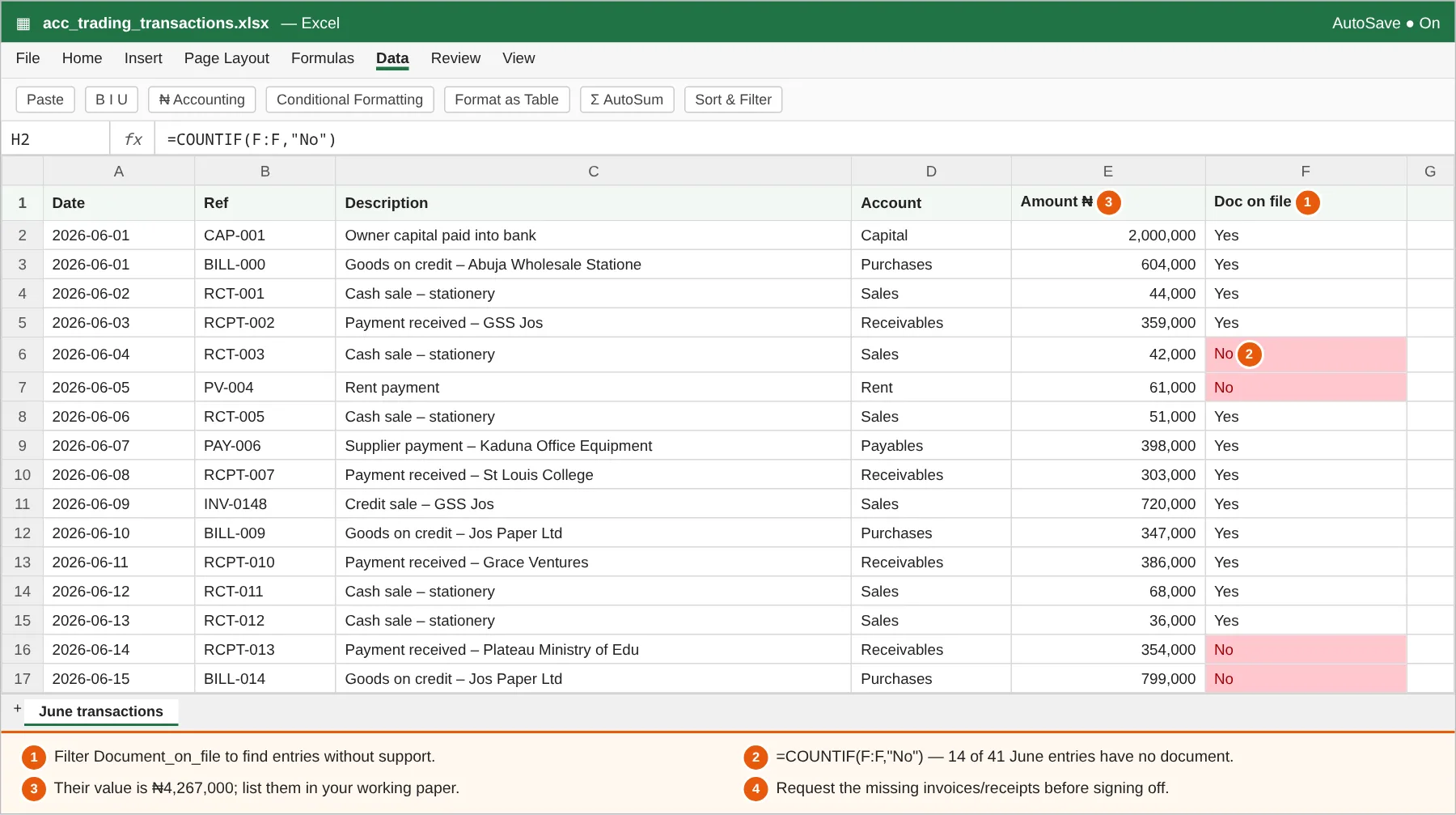
Try it yourself — step by step
- Open acc_trading_transactions.csv and turn on a filter (Ctrl+Shift+L).
- Filter Document_on_file to No.
- Count them: =COUNTIF(F:F,"No").
- Total their value with =SUMIF(F:F,"No",E:E).
- List each one in your working paper and request the missing documents.
Sufficient and appropriate evidence
Evidence must be sufficient (enough of it) and appropriate (relevant and reliable). External evidence, such as a bank confirmation, is more reliable than internal documents. Original documents beat photocopies. Evidence the auditor gathers directly — inspecting the renovated office — beats explanations from staff.
Vouching and tracing
Vouching starts from the accounting record and goes back to the supporting documents, testing occurrence: does each recorded payment have a valid contract, invoice, completion certificate and approval? Tracing goes the other way, from documents to records, testing completeness: was every delivery note recorded? Use both directions.
Verification procedures
Verification confirms existence, ownership and value. Inspect assets physically — the generator with serial number GEN-0042 should exist at the stated location. Confirm balances with third parties, such as a supplier statement or bank confirmation. Recalculate invoices, depreciation and VAT. Observe processes like cash counts. Use inquiry, but corroborate answers.

Build the prompt from three phrases — Role, Task and Format — and watch the AI answer.
Documenting findings
Record what you tested, the evidence seen, the result and any exception. For the renovation: 'PV 0921 ₦3,450,000 — invoice seen; contract, completion certificate and inspection report not on file; site visit on 14/07 found work partly complete.' Attach copies or references, sign and date, and pass for review.
Common mistakes to avoid
Common mistakes include accepting photocopies or screenshots without seeing originals, relying only on staff explanations, testing only in one direction, and writing vague notes such as 'checked, OK' without stating what was checked. Undocumented work is, for audit purposes, work not done.
Practice exercise
Vouch ten payments from the NGO expenditure sample. For each, list the documents present and missing, mark ✓ or ✗, and write a one-line conclusion. Then describe how you would verify one fixed asset physically and one supplier balance externally.
Lesson summary
Good evidence is sufficient and appropriate; external, original and auditor-obtained evidence is strongest. Vouching tests that recorded items occurred; tracing tests completeness. Verification confirms existence, ownership and value. Document every test clearly.
You are an internal auditor writing working papers. Document the test of a ₦3,450,000 renovation payment where only the voucher and invoice are on file as a working-paper entry with test, evidence seen, exceptions and conclusion.
Answer all three questions and check your answers to unlock the next lesson. Pass mark: 2 of 3.
Which evidence is generally most reliable?
Physically inspecting a generator against the asset register tests mainly…
Why is 'checked, OK' a weak working-paper note?